How to Read a Souvenir Without Treating It as a Whole Place
Learn how to read a souvenir’s maker, materials, display, and context so you can describe what it tells you about a place without overstating its meaning.
The common mistake with a souvenir is to let one object stand in for an entire place. A painted bowl, woven bag, or carved animal can become shorthand for a culture while the people, choices, and circumstances behind it disappear. Reading a souvenir as one object with a particular history—not as a spokesperson—leaves more room for curiosity.
What does a souvenir represent?
A souvenir is not a neutral sample of a place. Someone selected its form, materials, colors, and story for a particular setting: perhaps a market stall, museum shop, airport kiosk, or neighborhood workshop. Those settings shape what visitors see and what sellers expect them to recognize.
A motif may have a specific meaning in one community, a different meaning elsewhere, or no single shared interpretation at all. Even familiar labels such as “traditional” can flatten variation: they may describe a technique, a style chosen for visitors, or a seller’s way of distinguishing one item from another.
Look first at the object’s own clues. A tag, maker’s name, place of production, material, or description can tell you more than a broad label on a shelf. If those clues are absent, notice the gap rather than filling it with assumptions.
Should you focus on the object, maker, or display?
These three approaches answer different questions. The object-centered approach suits someone choosing by material and form. The maker-centered approach suits someone who wants to understand authorship and work. The display-centered approach suits someone examining how a place is packaged for visitors.
What can the object itself tell you?
Study how it is made and used: the joinery of a wooden toy, the glaze on a cup, or the edge finish of a printed cloth. These details can point to technique and function without claiming to explain a whole community. This approach is useful when you want to appreciate the craft without assigning a story its maker has not supplied.
Who made it, and for whom?
When a maker or workshop is identified, ask what the label actually establishes. It may name the place of production but not the source of a pattern, or name a designer without describing who carried out the work. Distinguish visible authorship from assumptions about origin, ownership, or cultural authority.
What does the shop’s setting add?
A souvenir beside postcards and luggage tags is being presented differently from a related object in a community-run craft center or museum collection. The display does not make the object false, but it can favor a neat, recognizable image of place. Notice how the setting encourages visitors to see it.
Choose the approach that matches your question, then keep its limits in view.
Which questions help restore context?
Where was the souvenir made?
Production location can differ from the place the object depicts or is sold in. A clear label may distinguish those places; a vague one may leave them bundled together.
Who designed, made, or commissioned it?
These roles can belong to different people or groups. Ask what the available information names instead of assuming one visible signature accounts for all the labor.
Is the motif used beyond the souvenir trade?
A pattern might appear in daily life, ceremonial settings, contemporary art, or only in products designed for visitors. Its use can change how you interpret it, so avoid assigning meaning from appearance alone.
What does the label leave unsaid?
Notice whether it offers a specific account or broad words such as “authentic” and “local.” Those terms may be promotional; they do not explain who chose the design or how its use is understood.
How can you describe a souvenir carefully?
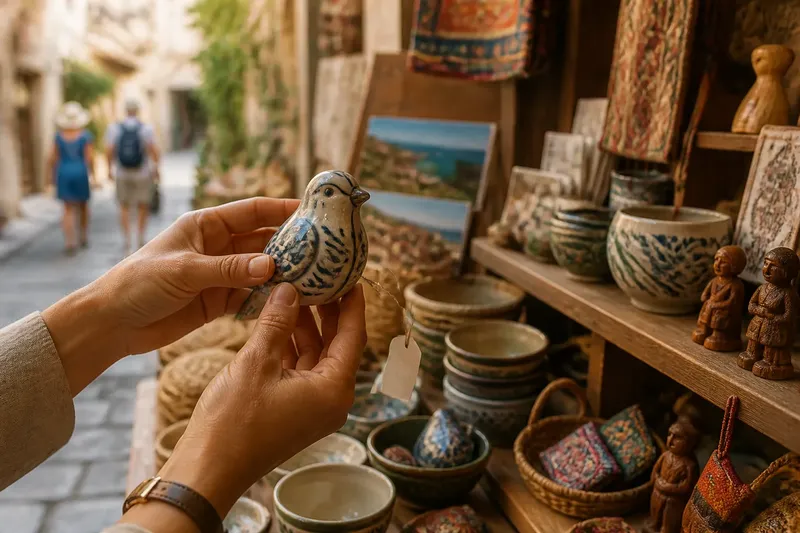
Imagine you find a small ceramic bird in a coastal town’s gift shop. Its tag says it was made nearby but gives no maker or explanation of the bird. You ask the shopkeeper whether a workshop is named, check the object for a maker’s mark, and learn that neither identifies a maker. You can describe it as a ceramic bird sold in the town, with a tag indicating nearby production, while leaving its maker and meaning unknown.
That account is limited, but it is more precise than calling the bird a symbol of the town. You can still value its shape, surface, or usefulness without turning uncertainty into a cultural claim. At home, a short description of what you know is more responsible than an invented origin story.
If you give a souvenir as a gift, share what you know and where you learned it. If its background remains unclear, say so plainly. The recipient can enjoy the object without being asked to treat it as a spokesperson.
What should you check before describing one?
- Check whether the label names a production location; if it does, describe that location specifically, and if not, avoid calling the object locally made.
- Check for a maker’s name or workshop; if one is identified, credit only the role the information supports, and if none is named, leave authorship open.
- Check whether the label distinguishes the designer from the maker; if it does, describe those roles separately, and if it does not, do not assume they were the same person.
- Check whether a motif’s source or use is explained; if a source is named, attribute the explanation to that source, and if not, describe the visible pattern without assigning meaning.
- Check whether words such as “authentic” or “traditional” have a specific explanation; if they do, repeat the stated detail, and if they do not, treat them as broad promotional labels.
- Check how the shop displays the object; if it groups it with place-themed souvenirs, note that presentation, and if the display gives no context, do not infer a community-wide meaning from the arrangement.
These checks can overlap, but none turns one item into a full account of a culture. A useful souvenir is one you can describe carefully: what it is, what you know about its making, and what remains open.
Before repeating a motif’s story, check whether the source identifies a person, community, or use—or merely attaches a place-name to a design. That pause keeps the object available for curiosity instead of letting it close the conversation it could have begun.