A Gallery Visit with One Material in Mind
A gallery visit with one material in mind turns a familiar material into a way to compare light, scale, and display—and leave with sharper questions.
The most common mistake on a gallery visit with one material in mind is treating the material as a label rather than a thread. You spot wood, glass, or clay and move on; what you lose is a chance to see how display, lighting, and distance change the way that material meets the room.
Instead of comparing how objects are made, follow how they occupy space. Notice what draws your eye from the doorway, what becomes visible as you move, and how a work relates to walls, windows, circulation, and neighboring pieces. This keeps the visit focused on the gallery as a designed environment, not on guessing techniques or intentions.
How does a material shape the room?
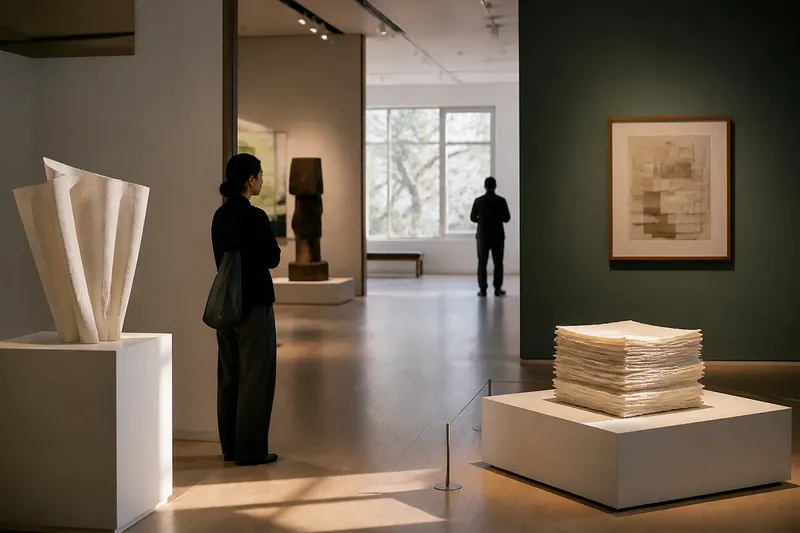
A material can affect the atmosphere of a gallery through its relationship with light and space. A glass work may leave sightlines open, while a dark, dense form may interrupt them; a pale paper installation can become especially prominent against a saturated wall. These effects depend on the particular work and its setting, rather than belonging to the material alone.
Choose a material you can recognize across different forms, such as glass, timber, paper, or metal. At the first work, note where it sits in the room and what you notice from the entrance. Then move, if the gallery allows, and see whether your view changes.
Start with the room’s arrangement, not a verdict about the work. Ask what becomes visible, blocked, or newly connected from where you stand.
What can the display tell you?
A plinth, wall bracket, case, or suspended wire does more than hold an object in place. Display can separate a work from its surroundings, bring it closer to eye level, or make the space around it part of the experience. The same material may feel intimate in a case and monumental when it occupies a central passage.
Notice the boundary between artwork and architecture. Is there a gap between the object and wall? Does a case reflect the room back at you? Does a plinth create a clear island, or does the work seem to continue into the floor’s visual field?
Labels and installation notes can clarify decisions you cannot infer from the room alone. Read them after looking if you want to keep your first impression separate from the explanation.
How can you compare works through space?
Rather than sorting works into a shared category, compare their positions and effects on movement. One may invite a direct approach; another may require you to look from the side. A third might appear different as visitors pass between it and the entrance.
Use these prompts to record what the installation makes observable. For each item, check the feature and follow the decision that fits what you see:
- Entrance view: Check whether the work is visible as you enter; if it is, note what frames it, then compare that framing with a work deeper in the room.
- Walking route: Check whether visitors pass beside, around, or in front of the work; if the route is clear, note how the work directs movement, but if it is interrupted, observe where the flow changes.
- Wall relationship: Check whether the work touches, hangs near, or stands apart from a wall; if it is close, note how the boundary affects its outline, but if it is freestanding, compare the views from either side.
- Light: Check whether daylight, gallery lighting, or reflections alter the view; if the surface changes with your position, note the shift, but if it remains visually steady, compare its contrast with nearby surfaces.
- Neighboring works: Check what is visible beside or behind the work; if another piece shares its sightline, note whether the pairing sharpens or competes with its presence, then compare a less crowded view.
- Viewing distance: Check whether you can see the work comfortably from where visitors are permitted to stand; if you can, compare its overall shape with its details, but if you cannot, record the larger silhouette rather than moving past barriers.
Say you enter a gallery with three paper works: a folded form near the doorway, a framed collage on a side wall, and a stack placed in the center of a room. From the entrance, you note that the folded form is immediately visible; after walking around the stack, you see that it blocks part of the collage, so your resulting comparison is about changing sightlines, not a claim about the works’ shared purpose.
What changes when a room is crowded or the view is distant?
A crowded gallery can obscure sightlines and make it difficult to pause. Choose a position that does not block the route, then look for a view that remains available as visitors move. If the room stays busy, compare the works from its edge rather than trying to reach every display.
Distance can reveal how a work relates to the whole room, while a closer view may show how its outline meets a case or wall. Move only where permitted, and do not cross barriers or interrupt other visitors’ access. When you cannot approach, use the broader view to consider scale, placement, and the open space around the work.
Which questions help you plan a material-focused gallery visit?
How many works should I follow?
Choose a handful that occupy noticeably different positions, such as one near an entrance and another deeper in a room. If their spatial relationships begin to feel repetitive, stop adding works and look again at the room’s arrangement.
Should I read gallery labels first?
Look at the installation before reading, then use labels to clarify materials, context, or display choices. If a label changes your interpretation of the setting, return to the work and see what detail it helps you notice.
Can furniture and architecture be part of the comparison?
Yes, when they shape sightlines or movement. A bench, rail, doorway, or glass partition can help explain why a work is approached from one direction rather than another.
What should I write down?
Record a position, a visible relationship, and a question for each work that holds your attention. For example, note that a sculpture stands between the entrance and a window, then ask how that placement changes the view across the room.
How can you carry the visit beyond the gallery?
Before leaving, recall one view that changed as you moved through the room. A piece that first seemed isolated may turn out to frame a doorway; a work that looked small from the entrance may command more attention from the side. These are observations about the space as well as the object.
A gallery visit with one material in mind becomes more useful when you follow placement, sightlines, and the visitor’s route alongside the material itself. Keep the material as a thread, but let the room set the questions: what does its arrangement bring into view, and what does it keep just out of sight?